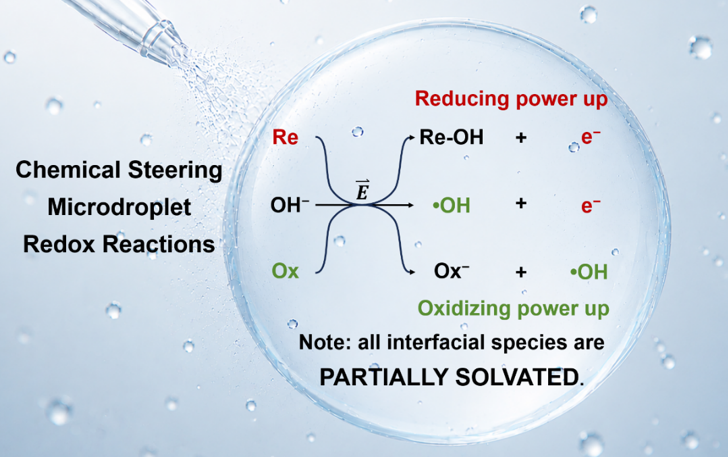
Partial solvation at the gas-liquid interface alters reaction energetics and contributes to the accelerated and unusual reactivity of water microdroplets. Here, we demonstrate that partially solvated electrons at the air-water interface of microdroplets can be chemically regulated to achieve extreme metal cation-to-anion reduction under mild conditions. Previous studies have shown that strong interfacial electric fields in water microdroplets are associated with the generation of hydroxyl radicals (•OH) and reducing interfacial electrons. Selective •OH scavenging regulates the availability and reaction pathways of these electrons, markedly increasing the reducing power of the interface. Although only trace Ag⁻ is generated from Ag⁺ in unregulated microdroplets, •OH scavenging with weak reductants such as DMPO and oxalic acid increases the Ag⁻ signal by up to approximately 100-fold and further enables the formation of Au⁻ and Cu⁻ through multielectron reduction of Au³⁺ and Cu²⁺, whereas electron scavenging completely suppresses Ag⁻ formation. Thermodynamic analysis indicates that the reducing eelectrons are neither free electrons nor fully hydrated electrons but partially solvated interfacial electrons with reducing power between the two. This finding helps explain the extreme reducing capability of water microdroplets and expands the recognized limits of microdroplet reduction chemistry.(DOI:10.31635/ccschem.026.202608586)