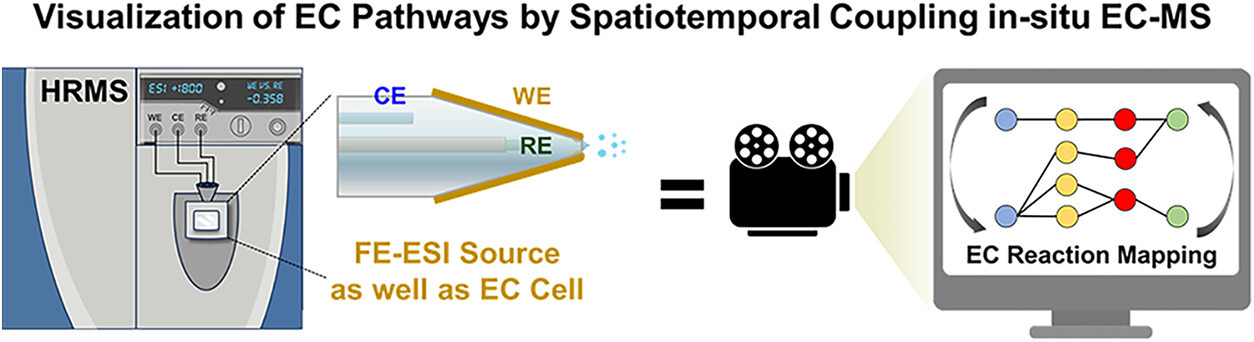
Electrochemical (EC) CO2 fixation and conversion are of great significance for enabling green synthesis and achieving carbon neutrality. Homogeneous metal complex-mediated CO2 reduction systems feature highly complex reaction pathways that evolve rapidly in response to external conditions and applied potentials, calling for spatiotemporally coupled in situ mass spectrometry (MS) capable of characterizing key intermediates and monitoring multiple reaction species in real time. However, the intrinsic conflict between the operational requirements of MS ionization and those of EC reactions has long hindered their highly spatiotemporal coupling. In this study, we introduce a floating-ground electrochemical electrospray ionization (FE-ESI) strategy that enables continuous and precise control and measurement of EC potential/current during ESI-MS analysis, fundamentally resolving the long-standing challenge of their spatiotemporal coupling. The resulting system has allowed EC as well as MS detection and characterization of microsecond-scale transient intermediates before they undergo further transformation. In the study of phenanthroline-copper complex-catalyzed CO2 reduction, we successfully captured a series of reactive copper cluster intermediates, directly verified─for the first time in experiment─the Girard isomerization process of the phenanthroline-copper catalyst, and elucidated the underlying mechanism by which the ligand and copper center cooperatively regulate CO2 reduction selectivity. (DOI:10.1021/jacs.6c02004)