Ferroptosis, an
iron-dependent form of regulated cell death driven by lipid
peroxidation, manifests with pronounced single-cell heterogeneity that
often dictates the cell fate. Conventional bulk-scale lipidomic analyses
obscure early-stage oxidative signatures and intercellular
stochasticity, while current single-cell mass spectrometry (MS)
workflows are frequently hampered by nonselective sampling and severe
ion suppression from biological matrices, leading to substantial
experimental and computational overhead. To address these limitations,
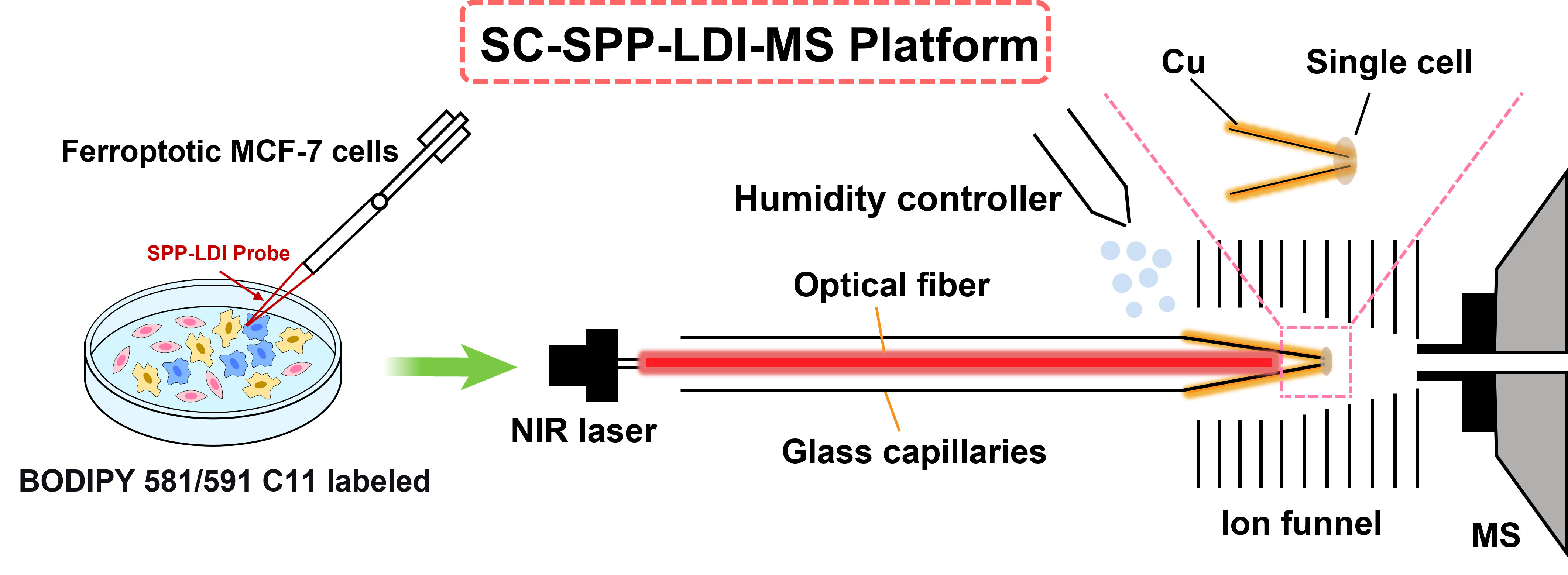
we developed a fluorescence-guided surface plasmon polarization laser
desorption ionization mass spectrometry (SPP-LDI-MS) platform designed
for the targeted collection and high-resolution lipidomic profiling of
individual cells. This synergistic approach utilizes lipid
peroxidation-responsive fluorescent probes to initially screen and
define the oxidative trajectories of the cell population. Targeted
single cells are subsequently captured and transferred onto the apex of a
copper-coated tapered capillary via a custom-designed SPP-LDI probe.
Within this microinterface, the surface plasmon polarization-enhanced
electromagnetic fields facilitate the direct laser soft ionization of
intracellular contents. We demonstrate that the SPP-LDI configuration
effectively mitigates salt- and buffer-induced ion suppression, markedly
elevating lipid detection sensitivity and molecular coverage at the
single-cell level beyond the limits of traditional nESI methods.
Application to an RSL3-induced ferroptosis model enabled the precise
identification of doubly and triply oxidized polyunsaturated
phospholipids at the single-cell level, the accumulation of which was
reversibly modulated by selenomethionine (SeMet) intervention. This
state-guided lipidomic strategy provides a robust analytical framework
for resolving stage-specific lipid remodeling, offering new insights
into the molecular mechanisms underlying cellular heterogeneity in
ferroptotic pathways.(DOI:10.1021/acs.analchem.6c02789)