Microdroplet
chemistry has garnered increasing attention due to the discovery that
extreme redox reactions can spontaneously occur at droplet interfaces.
Most current studies rely on ensemble-averaged aerosol behavior, yet
each microdroplet may exhibit vastly different reactivities depending on
its size and charge polarity. To address this problem, we developed a
dielectric barrier electrospray platform, which treats the entire liquid
volume confined within the emitter tip as a single stationary
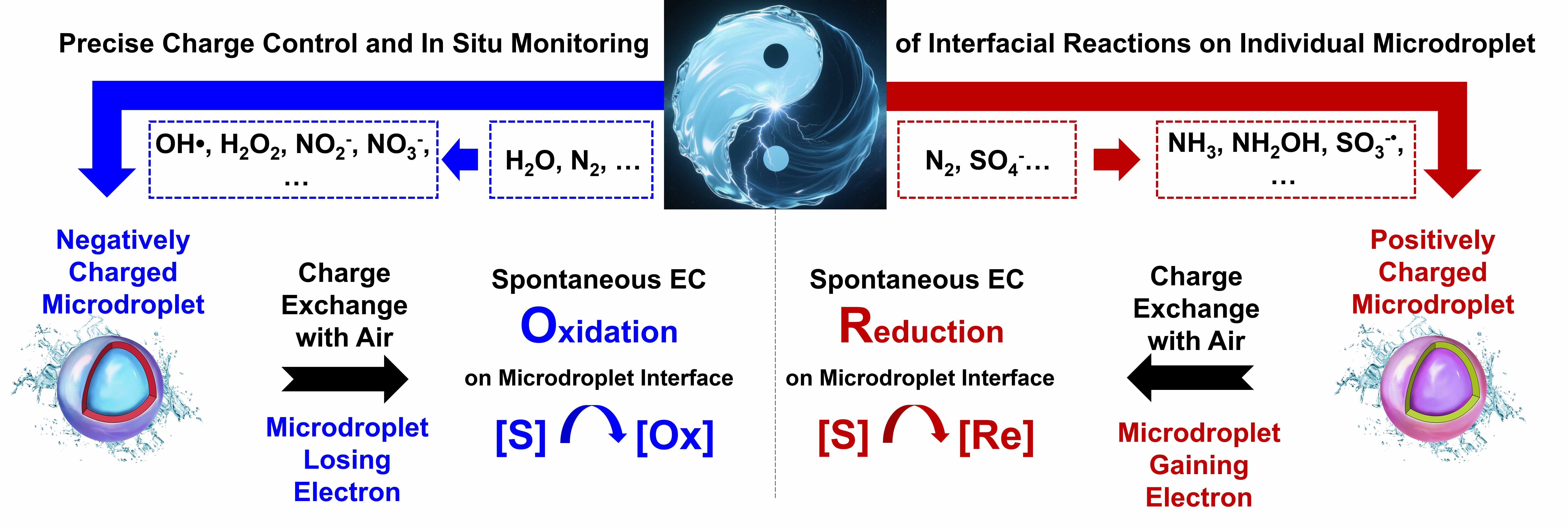
microdroplet reactor. This setup enables precise charge control and in
situ monitoring of interfacial reactions in this isolated,
picoliter-to-nanoliter droplet. Our results reveal that redox processes
at microdroplet interfaces can proceed as spontaneous interfacial
electrochemical reactions, driven by the polarity of microdroplet
charge. The reaction mechanism can be explained well by a modified
microdroplet electric double-layer model. The reaction Faradaic current
was measured at 58 pA, corresponding to a current density of 1.7
mA/m2─remarkably consistent with estimations of charged microdroplet
activity in atmospheric clouds. With this platform, we demonstrated that
the disproportionation of nitrogen at microdroplet interfaces
originates from the reaction polarity being defined at the
single-droplet level by its charge, each selectively catalyzing the
oxidation or reduction of N2. These findings not only shed light on the
atmospheric nitrogen cycle but also offer critical theoretical guidance
for future bulk nitrogen chemistry enabled by microdroplet catalysis.(DOI:10.1021/acs.analchem.5c06042)